
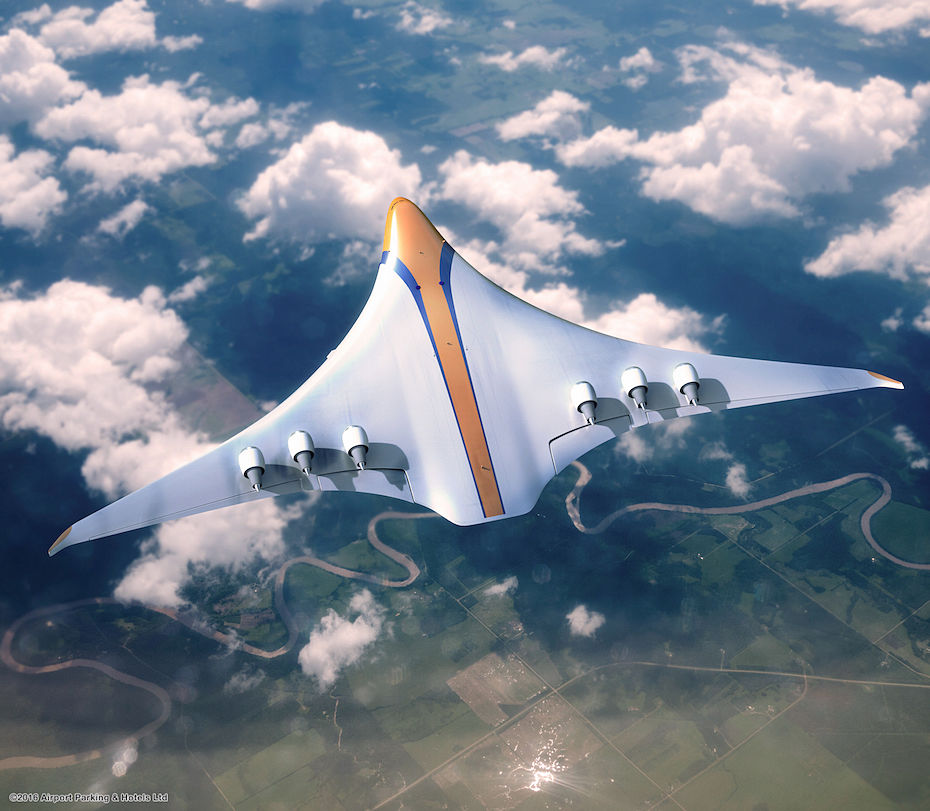
Airport Parking and Hotels (APH) partnered with specialists in aircraft design at Imperial College London to create a computerised 3D model that shows what the future of air travel will realistically look like within the next 30 to 40 years.
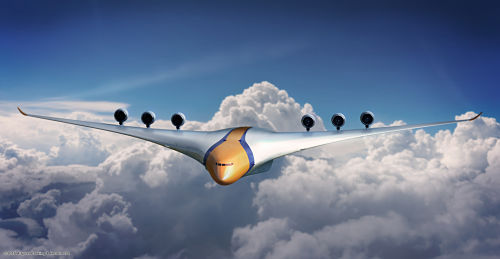
It reveals that aircraft are likely to become almost unrecognisable compared to the models of today, adopting a new design of blended-wing-bodies with larger wings, which can include extra cabin space and a wider fuselage with vastly increased capacity.
Future air travel power
Power will come from a mixture of small biofuel engines and fans powered by electric motors. This means that traditional kerosene fuel will be a thing of the past and aircraft will produce a fraction of the emissions currently produced by complete gas turbine propulsion.
The new aircraft will feature turboelectric motors above the fuselage. Apparently, locating the motors here takes advantage of aerodynamic advantages such as boundary layer ingestion – sucking in the viscous layer of air between the atmosphere and the aircraft body – reducing drag.
future air travel design
It will also provide a more pleasant flying experience, with much more space, transparent LCD screens built into the cabin walls to mimic windows, and wraparound virtual reality headsets built into the seats.
 Meanwhile, the larger cabins will allow for more space for in-flight bars, together with separate lounge areas to allow passengers to venture from their seats and socialise more freely during their journeys.
The research also gives examples of how some airports are already leading the way in efficiency, such as Cochin International Airport in India, which gets 100% of its energy from solar panels.
What the experts say
Beverley Barden, head of marketing at Airport Parking and Hotels, said: “Leisure and business air travel is becoming increasingly important to our way of life and many countries are waking up to the need to realise the impact of this on the environment.
“Through working with Imperial College London, we have been able to create this groundbreaking model of what air travel will realistically be like in 30 years or so. It’s very exciting to see what is already set to change in a relatively short time.
“These concepts might seem futuristic, but the technology is in development today – and it’s exciting to imagine all the changes we’ll see to commercial flight in the years ahead.”
 Adam Omar, who is studying for a PHD in Aircraft Design at Imperial College London, believes that as we move further into the future batteries and hydrogen fuel cells will advance to the point where aircraft produce no harmful emissions at all.
He said: “Weight reduction and an increase in fuel and aerodynamic efficiency have always been the primary goals of aircraft design.
“In the coming decades, a shift to novel propulsion technologies and alternate fuels seems very likely, both for economic and environmental reasons.”
Find out more about the future of flight.
2 comments
Wow really interesting post. I wonder if they will really look like that or not haha. I guess we’ll see in 30, 40 years! 😛 have a great week! x
adventurousmiles.com
Thanks Roberta – yes, it will be very interesting to see how aviation designs develop… Watch this space!