

Language is a funny thing. Being married to a language teacher has taught me that much – and boy have a learned a lot!
Language surrounds us and we take it for granted; from intimate messages with family members to instructions for work colleagues; from jokes shared with friends to lectures delivered to naughty children.
Over our lifetimes we accumulate a wealth of linguistic knowledge and years of experience teach us the steps in the dance routine that is everyday communication. It’s only when someone messes up the steps that you notice.
“It doesn’t matter”
If you’re a regular reader of this blog you might be aware that I publish a monthly community magazine. It’s my full-time job and every month I receive 7,000 copies to my door, ready for the distributors to pick up.
A few weeks ago, it was delivery day – the weather threatened rain and I was concerned that the boxes housing the magazines would get wet. With my best winning smile, I could usually persuade the delivery driver in question to help bring the boxes into my hallway, suitably socially distanced of course. I know it is a favour and something that the driver is not obliged to do, but one look at my strapped-up arm thanks to lymphedema (the result of cancer surgery) normally elicits a reaction of humanity…and hey presto…a dry parcel.
On this particular occasion, however, it wasn’t the fact that the driver was eager to adhere to COVID regulations (totally understandable – but sometimes I think the ‘Covid card’ is overused to suit a situation), but rather the way in which he declined my request.
At this point I should highlight the fact that everything about this man was rude and dismissive; his body language, tone and finally…his language. I told him that I accepted that he couldn’t bring the boxes into the house (even though I offered to wait at the back of the house in the kitchen so I could abide by his Covid rules), but I did point out that his customer service skills left a lot to be desired.
His response?
“It doesn’t matter.”
“It doesn’t matter?” I repeated back to him… “It matters to me!”
By this point I was riled and vowed to report him. After all, I was paying a lot of money for these magazines and you expect polite service don’t you? He was, after all, representing the company I was buying from.
“What’s your name?” I asked.
“Kosmere” he told me… “But I told you…I cannot bring into house”.
From his name and accent, I knew that Kosmere’s first language wasn’t English, so I tried again to tell him that wasn’t my point.
“I don’t care you can’t bring them inside but what I care about is the way you speak to me, you’re being very dismissive.”
One look at Kosmere’s face told me I had just wasted my breath. He hadn’t understood a word I was saying.
Instead, he gestured towards the paperwork I had to sign. I felt like saying “Covid rules, can’t touch pen” but thought better of it. I was going to be the bigger person in this scenario. I shut the front door leaving 36 boxes piled high in the porch.
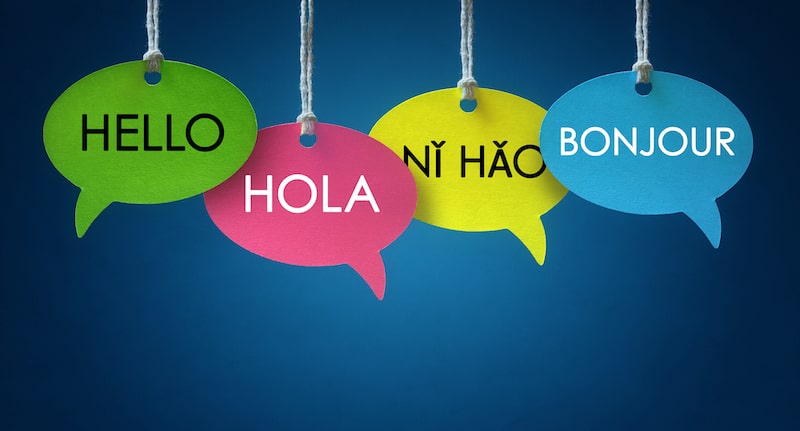
Lost in translation reflection
I did report Kosmere – and I would have done the same with anyone who I felt I’d received really poor service from. But it was just a few days later when I was reading in bed one night that the incident with Kosmere popped back into my head. And it suddenly dawned on me.
I had heard Kosmere’s “didn’t matter” comment and I had taken this literally. What he was possibly trying to say to me was “It’s not a problem”, but ‘doesn’t matter’ and ‘no problem’ mean two entirely different things. The penny dropped that this really was a language barrier moment and I had taken it very personally.
And the moral of the story? Well, Kosmere certainly wasn’t out to get me – and in the heat of the moment I had failed to understand that what I thought was his dismissive comment was actually him trying to smooth over the verbal exchange.
Don’t take language at face value; there is sometimes hidden meaning behind words, especially when liaising with people with whom English isn’t their first language.
English is bedevilled with the potential to cause unintentional offence, as anyone who has frequently put their foot in it can attest. Getting it right can make all the difference from winning or retaining clients to turning round a complaint.
The fact that VIP is a language teacher has made me all the more aware of this. The pressure of the dreaded speaking exam has led candidates to dropping such bombshells as: “ich lecke meine Freunde” (I lick my friends) when they meant to say ‘I like my friends’ all the way to complaining “ich war heiß’ (I was horny) when he is pretty sure they meant to say that they were hot. Now these are fairly innocuous, albeit embarrassing, but what about if the stakes are higher?
Other language mishaps
During a visit in the 1970s to Poland, President Carter’s interpreter seemed to suggest that President Carter was more than platonically interested in the country when he has intended to say that he wanted to lean about the Polish people’s “desires for the future”. Later on in the trip, Carter’s message of being happy to be in Poland was rendered as him being “happy to grasp at Poland’s private parts”.
Other innocent mistakes can lead to other kinds of misunderstandings. When astronomer Giovanni Virginio was mapping the surface of Mars in the late 19th century, he labelled the various channels on the planet canali which is the Italian for ‘channel’ but also for ‘canals’. What were naturally occurring topological features had suddenly become the work of extra-terrestrial beings on the red planet.
Hand on heart, hearing stories like this delight me – it reaffirms that I’m not the only person who occasionally messes my words up; I always said I’m much better at writing than I am at speaking – and it’s true. Hearing me talk you probably wouldn’t think that I was capable of writing a blog, let alone keeping it up for over 7 years.
So, going back to language and translation and my recent encounter with Kosmere – it’s no surprise that most businesses don’t take any chances with the whole ‘lost in translation’ thing when it comes to customer service and use professional translation companies such as Day Translations.
One wrong sentence in a document, letter or saying it out loud to someone can leave a bitter taste – and when it comes to doing business, it’s common sense that we avoid that at all costs.
As Marcus Fabius Quintilian once said, “One should not aim at being possible to understand but at being impossible to misunderstand.”
Now just to get that message through to the Kosmeres of this world…
You might also like…
This is a collaborative post with Day Translations
5 comments
I thought I would drop by to say hello… I hope you had a wonderful Christmas. All the best for the new year!
Oh Lauretta, I could feel your frustration! You handled yourself so well. I’ve really enjoyed reading about this, you’re right, intention can really be misread. I’ve had more than my fair share of foot in my mouth moments – it truly sounded better in my head than it did out loud. Whoops! You live and you learn, right? xx
Thanks Alex – and yes, we do live and learn and sometimes I think that I’ve had more than my fair share of ‘foot in mouth’ moments. But I try not to dwell on them and would rather just laugh them off – and learn from them of course. Thanks for reading!! xx
Lost in translation reminds me of the road sign which was translated wrongly… Somebody emailed a Welsh translation department for a translation of a sign. They put the text they received onto the road sign… and it turned out to be an “out of office” reply! 😀
Ha ha! That’s brilliant Nikki! I guess we’ll always have misunderstandings and mistranslations in life – keeps life interesting (and funny!). Thanks for reading 🙂